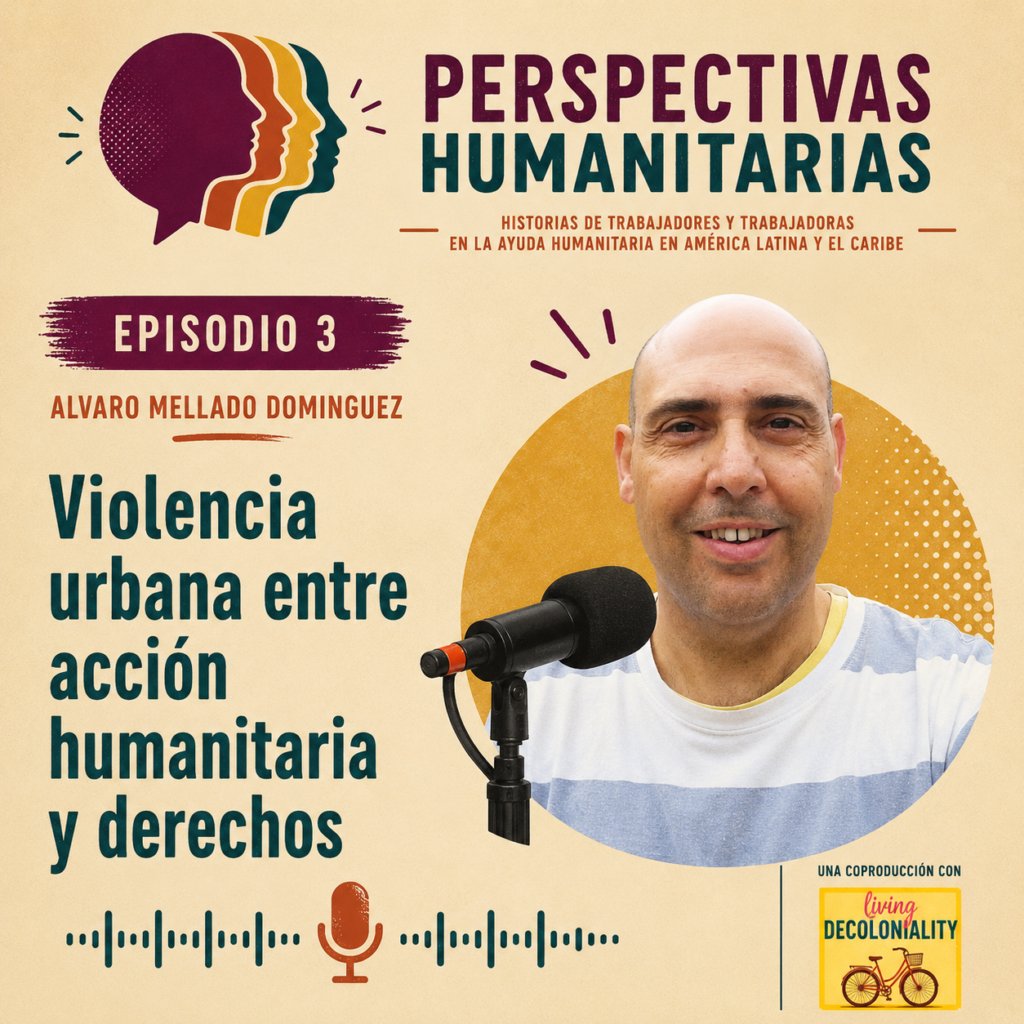
Episodio 3, Violencia urbana entre acción humanitaria y derechos
ENGLISH BELOW
[Música]
Estás escuchando “Perspectivas Humanitarias”: opiniones, reflexiones y dudas desde y sobre la ayuda humanitaria
en América Latina y Caribe, un podcast de Carla Vitantonio con el apoyo de Matilde Dani.
[Música]
Venía de contextos como Darfur y Siria, donde ahi la Violencia era por lo general
bombardeo, grupos armados, francotiradores en Siria, y los conflictos entre los diferentes grupos armados
en espacio abierto o cerrado en la ciudad. Y la violencia, que me encontré en Buenaventura,
me impactó profundamente. Era una cosa, una violencia, bastante silenciosa, cotidiana,
bastante psicológica y basada en el miedo. Y el control territorial invisible,
no había la frontera, pero había como un aspecto psicológico que me empezó a dar
la vuelta y a llamar la atención. Me acuerdo de una mujer que evitaba diariamente cruzar
una calle con el hijo que iba al colegio, porque decía que allí, cuando había niño,
lo llamaban ‘informante'”, y la verdad que aquí había una frontera invisible porque la mujer
decía que contaba cómo miraba a todos lados, como evitaba el sitio y a mí eso me recordaba
bastante el contexto de Siria, una ciudad en el norte de Siria, donde hay francotiradores,
donde la gente tiene que mirar por todos lados. Y ahí te das cuenta de cómo la gente tiene que
reorganizar su vida cotidiana y como el espacio que ocupa el grupo armado no es solo un espacio físico
encima de la calle, sino también un espacio mental, de cómo la gente se estructuraba
lo que seria calle en sí, antes de ir a la calle, como preparaba los movimientos y el aspecto
psicológico y mental de la parte no material estaba acostumbrada a los conflictos, me llamaba bastante
la atención en prisión, pero sobre todo el tema de la hiperviolencia, hablando de casas de pique,
cuerpos desmembrados, desapariciones, muestran temido, violaciones de niñas y comprendí que
ese mismo miedo se convierte en una forma de gobernanza que puede cambiar y cambió completamente la vida comunitaria.
La voz que escuchamos es de Álvaro Mellado Dominguez,
trabajador en el sector humanitario, investigador que he conocido a través de los observatorios
humanitarios. Álvaro, ¿quién es Álvaro?
Muy buena pregunta, la verdad que yo empecé primero haciendo enfermería y después, hice un diploma de enfermería en Londres, de enfermería tropical, y de ayuda humanitaria internacional
y me metí a trabajar allá con Médicos Sin Fronteras.
Con ello, he trabajado con Médicos del mundo con otras organizaciones,
pero principalmente estas con Médicos Sin Fronteras, contextos de África, Oriente Medio,
América Latina y las experiencias en Colombia, especialmente en Buenaventura de 2016 a 2024
me llevaron a muchas reflexiones sobre la violencia urbana, el miedo, la protección,
el lobby, movilizando a todos los actores, después mientras que hacía el trabajo humanitario,
hice una maestría en relaciones internacionales en Londres y un master en Bradford sobre conflicto, seguridad y desarrollo
en un departamento de estudios de paz, y estoy haciendo el doctorado en Barcelona sobre el espacio humanitario
y còmo lo perciben de manera diferente los actores armados en los contextos donde viven,
en la Universidad de Ramón Llull, la Facultad de la Blanquerna de Comunicación y Relaciones Internacionales.
¿Y por qué has decidido hablar de la situación que has descrito al principio del episodio?
Estamos viendo mucho en Latinoamérica, la problemática política, sobre desastres naturales,
de migraciones sobre todo el debate humanitario està basado en migraciones, pero yo veo que hay una gran importancia
el tema de la violencia urbana, sigue siendo una crisis bastante invisibilizada,
a pesar de que incluso organismos nacionales como la Defensoría llaman la atencion como alerta temprana,
ponen las problemáticas de este humanitario como que veo que no le da como preparo, no está respondiendo
bastante ni haciendo bastante lo que se llamaría advocacy o lobby ni tampoco a nivel humanitario.
Muchas veces, todo este problema se reduce a criminalidad, bandas urbanas y cuando la realidad implica de desplazamiento urbano
que lo ha vivido yo en equipo de 2024, desaparición y violencia sexual, ocultamiento, control territorial,
la amenaza de reclutamiento en los colegios, toque de queda por la noche en la ciudad.
Y no es simplemente que es lo visto solo en Buenaventura y en Quibdò también hay una historia en Medellín,
en Cali y hacemos una visión más panorámica y más generalizada.
Podemos ver que este problema está también presente en Ecuador y están presentes en México con los carteles,
en Brasil con las favelas y en los casos más extremos han tomado la capital y el país como puede ser en Haití.
Álvaro y cómo puede, según tu opinión, el sector humanitario abarcar ese tema desde qué perspectiva?
Creo que hay que entender las situaciones como emergencias complejas, quiere decir una emergencia compleja,
se definiría como un tipo de situación mayor de una crisis que involucra en diferentes emergencias,
pues de psicológica, desplazamiento, de salud, de protección, pero aparte de dar la asistencia,
si no se hace una cobertura, no hay respuesta de protección movilizando los actores,
pues no va a tener ni un impacto, tú puedes hacer un programa de salud mental o de psicosocial con niños en un barrio,
pero si no les aseguras que están protegidos, que no le va a pasar por las noches, eso debe ser central,
no es solo cuestión de mandar una clínica móvil, un psicólogo, dale de comer,
sino también garantizar que la persona como se ha visto en el ejemplo, pueda moverse a cualquier hora del barrio,
problema de tener que ir a trabajar, bueno, mismo miedo ir al colegio.
Es problema que muchos Estados no están preparados para conflictos rurales, campos de desplazados, sobre todo en África,
y el contexto como la violencia urbana, como he visto en Buenaventura o Quibdó,
no de desplazamiento que muchas veces son invisibles, porque la persona no quiere dar la alarma, ni sentirse aún más amenazada,
si siente que la han reportado a la autoridad y el miedo organiza completamente la vida cotidiana.
También creo que fue importante fortalecer la respuesta comunitaria, a nivel comunitario con la Junta de Acción Comunal en el caso de Colombia,
también mujeres lideresas locales, iglesias, las redes vecinales,
todo lo que el tejido social para que pueda movilizar al Estado, que es uno de los grandes retos,
que son hueco que el Estado no cubre, hay necesidades de seguridad, no tanto de seguridad, de poder ir
a trabajar o de poder moverte laboral tranquilamente, sino también de seguridad de tu propio derecho,
como poder decir lo que te está pasando.
Gracias Álvaro, escuchándote me pregunto si una respuesta a esa situación de violencia urbana,
entraría dentro de lo humanitario o de los derechos humanos?
Esa es una pregunta bastante compleja, porque siempre el estándar de emergencia está pensado para cosas masivas
y no para cien o doscientas personas, que es el umbral que el gobierno de Colombia no acepta como emergencia, más de 100 personas.
Pero se mueve entre una cosa intermedia, cuando hablas de derechos humanos, hablas del derecho a poder defender tu espacio
ecológico, el río, al derecho a la salud, a la educación, el derecho a poder organizar y expresarte.
Pero aquí el derecho humano se limita y se estrecha tanto, a un espacio bastante estrecho, que es de la misma supervivencia.
El poder sobrevivir, un derecho humano en que la persona si le ha pasado algo, acudir a la Defensoría, o pueda movilizar.
Entonces, no es el derecho humano amplio como se conoce, sino un derecho más limitado para sobrevivir.
Por un lado hablamos de necesidades humanitarias inmediatas, en el hecho de sobrevivir, el llamado a que la protección esté garantizada.
Pero también no solo eso a veces por la situación, tienes que darle alojamiento a la persona cuando se ha desplazado,
o tendré que evacuar a una persona por tema de amenaza y hacer una clínica móvil, dar alimento a las personas que están desplazadas, también el tema de agua.
Entonces estamos viendo que puede ser una respuesta compleja, pero lo que está en la base a todo otro tipo de problema de la asistencia y la necesidad de la protección.
Pero al mismo tiempo tienes el lado de los derechos, el derecho a poder lo que dice, lo que he comentado antes, podría haber la Defensoría,
a la no repetición, a la justicia y al final acabo el derecho más implicado con el principio humanitario de humanidad que es la dignidad.
Por eso pienso que se convierte en un puente entre acción humanitaria, el derecho humano, este tipo de violencia urbana que vemos en Latinoamérica
y que va a requerir un cuestionamiento no solo es esto humanitario, eso también de la reorganización política del Estado, aunque actualmente el tema de la criminalidad y la seguridad y la extorsión,
este en la campaña política, eso luego se está viendo demostrado el respuesta humanitaria, firme y sólida para que la gente pueda quedarse a vivir en su misma casa sin ser amenazadas y de entender el miedo,
de buscar una salida, de escape y ser desplazada a otra parte de la ciudad o a otra ciudad y es por eso que mientras que en un campo de desplazado en Gaza que se ven que está desplazado como se está viendo ahora
y la zona que nos controla por el largo israelita, aquí lo que pasa estos desplazamientos van a casa de familiares, para casa de vecinos, para a otros lugares como iglesias que no son tan evidente y pasan como desapercibidos.
Pero la necesidad está ahi, lo que pasa es que hay que buscar ser más proactivos que reactivos.
Gracias, bueno, te tengo una última pregunta, desde tu posicionamiento de profesional de la ayuda humanitaria que en este momento vive en Europa, ¿cómo tu ves el espacio humanitario?
Yo veo principalmente que en Latinoamérica, la focalización está en la migración, pero el problema de la violencia urbana se están haciendo más, incluso hace una semana la policía en Barcelona están activando medios y programas para la problemática
de las bandas en Barcelona. Yo veo que aquí hay una problemática que se está que no està todavía en la primera línea, pero que cada vez está expandiendose más, no solo en Latinoamérica.
Y después el tema de la migración se está securitizando en Latinoamérica y en África.
Y si ponemos un poco en perspecitva la necesidad de Latinoamérica, la agenda global lo es lo difícil con la problemática de Gaza, Ucrania, Sudán, Etiopía lo que es lo difícil que vuelva a una agenda global la problemática de Latinoamérica, pasó a mediado de la década entre el 2010 y el 2020 con otras situaciones de violencia en que se puso esta problemática, ahora lo que es difícil que vuelva y más tiene que ser más efectivo.
También veo que muchas comunidades se sienten bastante solas que gran parte de esa resistencia sigue siendo y viendo desde abajo, de derecha, organización comunitaria, iglesia y redes vecinales, que sostienen la vida cotidiana en vez de la violencia y cada vez la veo más aislada, si no hay una movilización por parte del Estado y de las organizaciones humanitarias, otra organización no gubernamental, ante esta respuesta
Entonces para esta problemática lo difícil y para la problemática general de Latinoamérica se está securitizando y va a entrar un mercado de la competencia de las necesidades para poder conseguir recursos y ser tomado en serio.
Muchas gracias Álvaro.
Gracias a ti.
Has escuchado perspectivas humanitarias, opiniones, reflexiones y dudas desde y sobre la ayuda humanitaria en América Latina y Carribe, un podcast de Carla Vitantonio con el apoyo de Matilde Dani.
Si te ha gustado dale like y suscríbete al canal en Spreaker, Spotify y Apple podcast.
Perspectivas humanitarias ha sido creado con el apoyo del Humanitarian Studies Center y del Observatorio Humanitario LAC, en coproducción con Living decoloniality.
[Música]
**************************************************************************************************************************************
Urban violence between humanitarian action and rights
[Music]
You are listening to “Humanitarian Perspectives”: opinions, reflections and questions from and about humanitarian aid in Latin America and the Caribbean, a podcast by Carla Vitantonio with the support of Matilde Dani.
[Music]
I came from contexts like Darfur and Syria, where violence was generally bombing, armed groups, snipers in Syria, and conflict between different armed groups in open or closed spaces in the city. And the violence I found in Buenaventura affected me deeply. It was something, a fairly silent, everyday violence, quite psychological, and based on fear. And invisible territorial control, there was no border, but there was a kind of psychological aspect that started to turn over in my mind and catch my attention. I remember a woman who would avoid crossing a certain street every day with her son on the way to school, because she said that there, when there was a child, they called him an “informant,” and it’s true that there was an invisible border there, because the woman said she noticed how she looked in every direction, how she avoided that spot, and that reminded me a lot of the context in Syria, a city in northern Syria, where there are snipers, where people have to look in every direction.
And that’s when you realize how people have to reorganize their daily life, and how the space occupied by an armed group isn’t just a physical space over the street, but also a mental space, how people would structure what the street itself would be before even going out into it, how they’d plan their movements, and the psychological and mental side, the non-material part, had grown used to the conflicts. That really caught my attention in prison, but especially the issue of hyperviolence, talking about “casas de pique” [dismemberment houses], dismembered bodies, disappearances, shown feared, rapes of girls, and I understood that that same fear becomes a form of governance that can change, and did completely change, community life.
The voice we’re hearing is Álvaro Mellado Domínguez, a humanitarian worker and researcher I met through the humanitarian observatories. Álvaro, who is Álvaro?
That’s a very good question. The truth is, I started out first in nursing, and afterward I did a diploma in nursing in London, in tropical nursing, and in international humanitarian aid, and I got into working there with Doctors Without Borders. Along with that, I’ve worked with Doctors of the World and other organizations, but mainly with Doctors Without Borders, in contexts in Africa, the Middle East, Latin America. And the experiences in Colombia, especially in Buenaventura from 2016 to 2024, led me to a lot of reflection on urban violence, fear, protection, lobbying, mobilizing all the actors. Later, while I was doing humanitarian work, I did a master’s in international relations in London, and a master’s in Bradford on conflict, security, and development, in a peace studies department, and I’m doing my PhD in Barcelona on humanitarian space and how it’s perceived differently by armed actors in the contexts where they live, at Ramon Llull University, at the Blanquerna Faculty of Communication and International Relations.
And why did you decide to talk about the situation you described at the start of the episode?
We’re seeing a lot in Latin America, the political issue, natural disasters, migration — the humanitarian debate has mostly been about migration — but I see there’s a lot of importance in the issue of urban violence, it remains a fairly invisible crisis, even though national bodies like the Ombudsman’s Office draw attention to it, like early warning systems, they flag the problems, but this humanitarian issue, I feel it isn’t given the preparation it needs, it isn’t responding enough, nor is it doing enough of what you’d call advocacy or lobbying, nor is it enough at the humanitarian level either.
Many times, this whole problem gets reduced to “criminality” or “urban gangs,” when in reality it involves urban displacement — which I’ve lived through myself, on the team, in 2024 — disappearance and sexual violence, concealment, territorial control, the threat of recruitment in schools, curfews at night in the city.
And it’s not just something seen only in Buenaventura and in Quibdó — there’s also a story in Medellín, in Cali, and if we take a broader, more panoramic view. We can see that this problem is also present in Ecuador, and it’s present in Mexico with the cartels, in Brazil with the favelas, and in the most extreme cases it has taken over the capital and the country, as can be the case in Haiti.
Álvaro, how do you think the humanitarian sector can take on this issue, from what perspective?
I think we have to understand these situations as complex emergencies — meaning a complex emergency would be defined as a kind of larger situation, a crisis that involves different emergencies at once: psychological, displacement, health, protection. But beyond providing assistance, if there’s no coverage, if there’s no protection response mobilizing the actors, then it won’t have any impact at all. You can run a mental health or psychosocial program with children in a neighborhood, but if you don’t make sure they’re protected, that nothing will happen to them at night, that has to be central. It’s not just a matter of sending a mobile clinic, a psychologist, giving them food — it’s also about guaranteeing that the person, as we saw in the example, can move around the neighborhood at any hour, without the problem of having to go to work, or, well, the same fear about going to school.
The problem is that many states are not prepared for rural conflicts, displacement camps, especially in Africa, and for a context like urban violence, as I’ve seen in Buenaventura or Quibdó, where displacement is often invisible, because the person doesn’t want to raise the alarm or feel even more threatened, if they feel they’ve been reported to the authorities, and fear completely reorganizes daily life.
I also think it was important to strengthen the community response — at the community level, with the Junta de Acción Comunal in the case of Colombia, also local women leaders, churches, neighborhood networks — everything that makes up the social fabric, so it can mobilize the State, which is one of the great challenges: that there are gaps the State doesn’t cover. There are security needs — not so much security in the sense of being able to go to work or move around for your job in peace, but also security around your own rights, like being able to say what’s happening to you.
Thank you, Álvaro. Listening to you, I wonder whether a response to this situation of urban violence would fall under humanitarian action or under human rights.
That’s quite a complex question, because the emergency standard is always designed for massive situations, not for a hundred or two hundred people — that’s the threshold the Colombian government doesn’t accept as an emergency, more than 100 people. But it moves in something in between. When you talk about human rights, you’re talking about the right to defend your ecological space, the river, the right to health, to education, the right to organize and speak out. But here, human rights get limited and narrowed down so much, to quite a narrow space, which is that of survival itself. Being able to survive — a human right where, if something has happened to a person, they can go to the Ombudsman’s Office, or can mobilize. So it’s not the broad human rights as they’re normally understood, but a more limited right, just to survive.
On one hand we talk about immediate humanitarian needs, about the fact of surviving, the call for protection to be guaranteed. But it’s also not just that — sometimes, depending on the situation, you have to provide shelter for a person who has been displaced, or you have to evacuate someone because of a threat and set up a mobile clinic, provide food to displaced people, and there’s also the issue of water. So we’re seeing that the response can be complex, but underlying every other kind of problem is the issue of assistance and the need for protection.
But at the same time you have the rights side — the right to, as I mentioned before, the Ombudsman’s Office could be there, the right to non-repetition, to justice, and in the end, the right most closely tied to the humanitarian principle of humanity, which is dignity. That’s why I think it becomes a bridge between humanitarian action and human rights — this kind of urban violence we see in Latin America — and it’s going to require questioning not just what’s humanitarian, but also the political reorganization of the State. Although right now the issue of criminality, security, and extortion is part of the political campaign, that then translates into needing a humanitarian response that’s firm and solid, so that people can stay living in their own homes without being threatened, and so as not to have to face the fear, look for a way out, an escape, and be displaced to another part of the city or another city.
And that’s why, while in a displacement camp in Gaza you can see people being displaced the way it’s being seen now, and the zone controlled by the Israeli side — here what happens is these displacements go to relatives’ homes, to neighbors’ homes, to other places like churches that aren’t as visible and go unnoticed. But the need is there — what happens is we need to be more proactive than reactive.
Thank you, well, I have one last question for you: from your position as a humanitarian aid professional currently living in Europe, how do you see the humanitarian space?
What I mainly see is that in Latin America, the focus is on migration, but the problem of urban violence is getting bigger — just last week the police in Barcelona were rolling out resources and programs for the issue of gangs in Barcelona. I see that here there’s an issue that isn’t yet on the front line, but that keeps expanding more and more, not just in Latin America. And then the issue of migration is becoming securitized in Latin America and in Africa.
And if we put Latin America’s needs in perspective a bit, the global agenda — it’s hard, with the problems of Gaza, Ukraine, Sudan, Ethiopia — it’s hard for Latin America’s issue to make it back onto the global agenda. It happened in the middle of the decade, between 2010 and 2020, with other situations of violence that put this issue on the map; now it’s hard for it to come back, and it has to be more effective.
I also see that many communities feel quite alone, and that a large part of that resilience keeps coming, and being seen, from below — community organizations, churches, and neighborhood networks that sustain daily life in the midst of violence — and I see it becoming more and more isolated if there isn’t mobilization on the part of the State and humanitarian organizations, another non-governmental organization, in the face of this response.
So for this issue, it’s difficult, and for the general issue in Latin America it’s becoming securitized, and it’s going to enter a competitive market for needs, just to be able to get resources and be taken seriously.
Thank you so much, Álvaro.
Thank you.
You have listened to Humanitarian Perspectives, opinions, reflections and questions from and about humanitarian aid in Latin America and the Caribbean, a podcast by Carla Vitantonio with the support of Matilde Dani. If you liked it, give it a like and subscribe to the channel on Spreaker, Spotify, and Apple Podcasts. Humanitarian Perspectives was created with the support of the Humanitarian Studies Center and the LAC Humanitarian Observatory, in co-production with Living Decoloniality.
[Music]
[Music]