Episodio 4, Haití y la narrativa de la victima
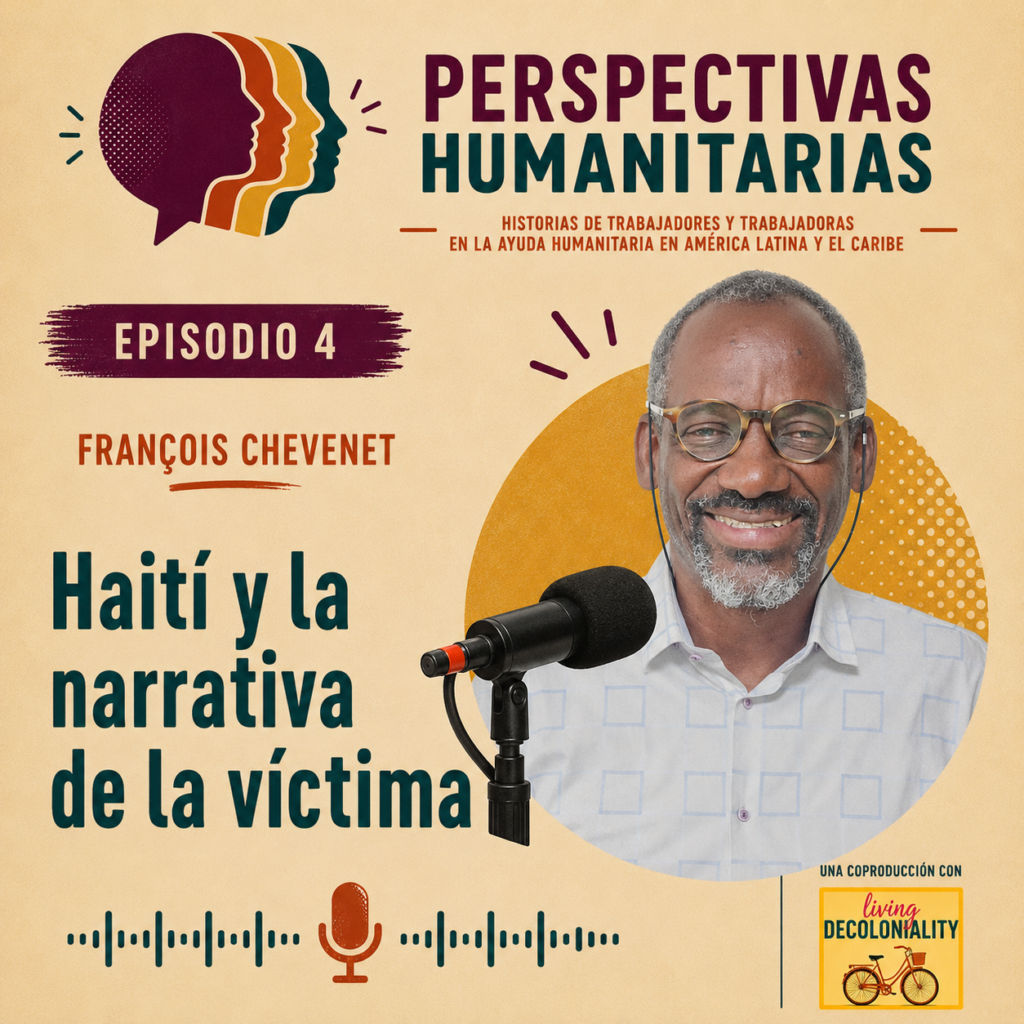
ENGLISH BELOW
[Música]
Estás escuchando Perspectivas Humanitarias, opiniones, reflexiones y dudas desde y sobre la ayuda
humanitaria en América Latina y Carribe, un podcast de Carla Vitantonio con el apoyo
de Matilde Dani.
[Música]
Buenos días y bienvenidas y bienvenidos a otro episodio de Perspectivas Humanitarias.
Yo soy Carla Vitantonio. Hoy le doy la bienvenida a François Chavenet desde Haiti.
Buenos días François.
Buenos días es un placer para mí estar contigo hoy para hablarte de mi país.
Yo te he conocido a través de una mujer, una lideresa, Marie-Rose Romain Murphy, cuyo trabajo ha
sido siempre de promoción de liderazgo local. Y sé que tú tienes una historia personal muy
interesante y muy diversa. ¿Quieres hablar un poco de ti para quien no se escucha?
Sí, con placer. Yo soy François Chávenet y soy hoy un contador público.
Mi oficina trabaja desde hace como 35 años y estoy muy satisfecho de lo que ha ido hasta
hoy porque tuve la oportunidad de viajar en todo el país y también a nivel internacional.
Mi familia sale de una zona, aquí no hablamos de departamentos,
Grand’Anse que están al sur de Haití aunque nací en Puerto Príncipe muy joven,
jovencito como desde los 10 años, mi padre era fin de año de escolar, nos llevaba allá y así
que tengo mucho gusto de hoy de estar viviendo allá.
Hace tres años que estoy casi siempre en Jérémie donde tenemos muchas iniciativas y también
es la región en la cual la fundación opera. Pero quisiera decir que tuve una infancia muy
agradable, tuve la oportunidad también de viajar con mi padre que era un diplomático así
que aprendí a hablar un poco de español mucho más inglés pero eso me dio una diferente
vista de la vida de los otros países y de los esfuerzos también que teníamos que hacer.
En mi familia había personajes muy interesantes pero rápidamente te voy a hablar
de mi tío era un revolucionario en el periodo de Duvalier, y con 19 otros trataban
de derrotar al dictador pero eso no terminó bien y los dos que quedaban eran uno de mis tíos
y otro muchacho que fueron fusilados el 12 de noviembre 1964 y eso es un evento que impactó
la familia porque la mayoría de los tíos se fue a Estados Unidos y el hermano de
ese que era embajador de Haití por Duvalier(?), se quedó también en ese país y es por eso que
hoy tengo sobrinos que son americanos y mi pasión personal, como paso mucho tiempo a plantar
árboles y todo eso a cuidar al ambiente.
Es muy interesante esa cosa que tú compartes que tu pasión es sembrar árboles y me hace pensar mucho en tu trabajo con la fundación
comunitaria de Haití de Haití Community Foundation vamos a hablar de esto en un momento
pero primero quisiera preguntarte cómo hombre nacido y crecido y criado en Haití me gustaría
confrontarme contigo, compartir contigo algo sobre la narrativa estereotípica sobre Haití.
Cuando pensamos en Haití como humanitarios y humanitarias desde afuera la narrativa dominante
es una narrativa que describe un país en permanente crisis humanitaria donde ninguna de las
acciones propuestas funciona un país en desorden, yo sé que tú no coincides con esa narrativa y me gustaría
escuchar tu punto de vista.
Bueno Carla eso es un sujeto que tú traes ahora para hablar pero lo que yo podía decir es que todo empezó con la revolución Haitiana.
Tú sabes que cuando esa revolución tuvo plazo, Haití era un país singular, estamos hablando de 803 cuando el mundo vivía en la esclavitud,
todo se hacía con esclavos y cuando tuvimos nuestra liberación ya empezó lo que llamamos
hoy bloqueos. Porque nadie quiso hacer negocios normalmente con nosotros no fuimos
invitados a un por los países latinoamericanos que hemos ayudado a obtener sus liberaciones y
fuimos forzados a pagar a Francia en 1825 como una compensación para los dueños de plantaciones
es una aberración y a través de estos siglos cada vez teníamos un evento invasiones Estados Unidos
invadiò Haití como dos veces, y ponemos la posición de Haití con los
huracanes. Y todo eso el terremoto que tuvimos en 2010 después en el sismo en 2021 parece que
a Haití es un país como que no tiene suerte o que es incapaz pero cuando miramos al mundo hay
muchos países que se presentan simul estadísticas o impresiones similares pero todo no tiene que ver con
el país mismo tiene que ver también con las condiciones internacionales que fuerzan a esos países
a situaciones difíciles y con esa deuda que tuvimos que pagar que no tomó más de un siglo pagar.
Todo lo que se podría invertir en el bienestar de la población salud, educación todo eso
no pudimos hacerlo porque 80% de las capacidades del país que van a pagar a esa deuda. El resultado es
que aunque el país mismo parece un desastre pero los Haitianos que viven a través del mundo cuando
llegan son muy trabajadores esa población trabaja si se va a la escuela se va la universidad y tienen
éxitos los pintores Haitianos los escritores y hoy estamos gozando de los futbolistas pero con un
equipo con los 26 hay solamente uno que sale de Haití los 25 otros salen de esta diáspora y
que maravilla para nosotros tener a disposición cuando el país está en bloqueo y en el aeropuerto principal
está cerrado tener esa reserva de personas para representar al país a la gran fiesta que del fútbol
internacional es una maravilla para mí y eso nos da mucho mucho alegría al país. Yo pienso que si
Haití que tenía una gobernanza que se ocupa del de las prioridades del país, y cuando miro a un país como
El Salvador que está haciendo que lo quieren o no, que está haciendo el Burkina Faso y va a
intra hoy cuando hay una gobernanza que se cuide al país miraculous pueden pasar, y yo creo en la
capacidad de los Haitianos a trabajar y reinventarse.
Te agradezco por regalarnos esta mirada al pueblo haitiano como un pueblo que, no es sencillamente una víctima, es un pueblo lleno de iniciativa de
creatividad y desde ese punto de vista me gustaría que tú hablaras un poco de la Haiti Community Foundation de la
Fundación a la cual tú perteneces y de la manera que tiene de trabajar en el sector que nos
interesa más, que es el sector de la ayuda humanitaria, pero también en una lógica de nexo vamos, ahí hacia el desarrollo verdad.
Tengo que decirte Carla que esa iniciativa la Fundación Comunitaria Haitiana
es una iniciativa de Marie-Rose en el país después del terremoto; sabes que el terremoto
fue una fecha que generó muchas iniciativas; hay muchas organizaciones que han empezado a trabajar para
mejorar las condiciones generales en Haiti; partimos de la base que un país es una tarea permanente y con
due exigencias en cualquier parte es como una cadena y se rompe y la verdad aparece y yo tengo que
decir de que la familia de Marie-Rose, la conozco de niño que estaba en el
mismo barrio así que cuando me habló de eso, y en ese momento yo estaba tratando de hacer cosas que
impactan a todo el país; las iniciativas que yo soporto son aquellas que pueden hacer en cualquier parte del
país, no solamente una región, o por una categoría de gente. Cuando hice los los análisis de
esa concepción de fundación comunitaria yo concluí que era una oportunidad para trabajar
de manera diferente porque tú sabes que Haití es un país que es conocido como el país con más
organización no gubernamentales, tenemos como más de 6000 o 7000 y la mayoría no está
autorizada. Así que cuando empezamos era en un ambiente donde las organizaciones financiadas por
extranjeros eran dominantes. Cada vez que había una situación humanitaria son los primeros
en obtener fondos, en detrimento de las organizaciones haitianas y ellos cuando obtienen cualquier fondo,
hay muchos reportes que lo confirman, solamente un pequeño porcentaje se queda en el país o está
invertido en el país. Esa es la primera característica de nuestra organización que hace una maximización
del uso de cada good que es nuestro unidad monetaria que se invierte realmente en las construcciones
en la población y tenemos un principio donde las comunidades invierten también fondos o
materiales para construcción, por ejemplo arena cemento y talentos que tienen y exigimos como 20%
debe salir de la comunidad. Estamos muy orgullosos de eso porque la mayoría de
organizaciones haitianas salen como más o menos a 5% de fondos locales y lo que hacemos
que es muy diferente no es combatir el fenómeno o las consecuencias, hacemos acciones que para
identificar líderes de las regiones y también darle el acompañamiento para mejorar los
proyectos que ellos mismos han determinado y estamos ahí para acompañar no para decirles que hacer.
Lo último en que estamos empeñados son como se dice, micro… micro credito, creditos mutuales como se diría, para donde la gente pone los propios fundos, lo ponen juntos para hacer inversiones y actividades
que van a generar más dinero para ellos crecer. Lamento que no tengamos más fondos para hacer
en permanencia acciones que podrían impactar, pero esperamos que lo poco que hacemos
inspire a la aventura, inspire a otras organizaciones, que cuando uno tiene un país tenemos
la responsabilidad primaria de hacer y no esperar que alguien salga de afuera para hacerlo
no estoy diciendo que no queremos ayuda pero uno se debe ayudar primeramente eso es la
filosofía de nuestra organización.
Te agradezco muchísimo François y lo que dices. Yo creo que va a tener mucho eco y mucho espacio en las reflexiones de todas las organizaciones locales en
América Latina y Caribe y gracias por hacer el esfuerzo de compartir tu punto de vista en español para nuestro público hasta el próximo episodio.
Has escuchado Perspectivas Humanitarias, opiniones, reflexiones y dudas desde y sobre la ayuda humanitaria en
América Latina y Caribe un podcast de Carla Vitantonio con el apoyo de Matilde Dani. si te ha gustado dale
like y suscríbete al canal en Spreaker, Spotify y Apple Podcast perspectivas humanitarias ha sido creado con el
apoyo del Humanitarian Studies Center y del Observatorio Humanitario LAC en coproducción con
Living Decoloniality.
[Música]
**********************************************************************************************************************************
ENGLISH VERSION
04 Haiti and the narrative of the victim
[Music]
You are listening to Humanitarian Perspectives, opinions, reflections and questions from and about humanitarian aid in Latin America and the Caribbean, a podcast by Carla Vitantonio with the support of Matilde Dani.
[Music]
Good morning and welcome to another episode of Humanitarian Perspectives. I am Carla Vitantonio. Today I welcome François Chavenet from Haiti.
Good morning, François.
Good morning, it’s a pleasure for me to be with you today to talk to you about my country.
I got to know you through a woman, a community leader, Marie-Rose Romain Murphy, whose work has always been about promoting local leadership. And I know you have a very interesting and very varied personal history. Would you like to talk a bit about yourself, for those listening who don’t know you?
Yes, with pleasure. I am François Chavenet, and today I am a public accountant.
My office has been running for about 35 years now, and I’m very satisfied with how things have gone up to today, because I had the chance to travel all over the country and also internationally.
My family comes from an area — here we don’t talk about “departments” — Grand’Anse, which is in the south of Haiti, and although I was born in Port-au-Prince, when I was very young, just a little kid, about 10 years old, my father worked at the end of the school year, and he’d take us there, so I’ve always really enjoyed living there.
For three years now I’ve been almost always in Jérémie, where we have many initiatives, and it’s also the region where the foundation operates. But I’d like to say that I had a very pleasant childhood; I also had the chance to travel with my father, who was a diplomat, so I learned to speak a little Spanish, much more English, but that gave me a different view of life in other countries, and of the efforts we had to make too.
In my family there were some very interesting characters, but I’ll quickly tell you about my uncle — he was a revolutionary during the Duvalier period, and along with 19 others he tried to overthrow the dictator, but that didn’t end well, and the two who were left were one of my uncles and another young man, who were executed by firing squad on November 12, 1964. That’s an event that had a huge impact on the family, because most of the uncles left for the United States, and the brother of the one who had been ambassador for Haiti under Duvalier(?) also stayed in that country. That’s why today I have nephews who are American, and my personal passion — I spend a lot of time planting trees and taking care of the environment in general.
It’s very interesting, this thing you share, that your passion is planting trees, and it makes me think a lot about your work with the Haiti Community Foundation. We’ll talk about that in a moment, but first I’d like to ask you, as a man born, raised, and brought up in Haiti, I’d like to bring up with you, to share with you, something about the stereotypical narrative about Haiti. When we think about Haiti as humanitarians looking in from outside, the dominant narrative is one that describes a country in permanent humanitarian crisis, where none of the proposed actions work, a country in disorder. I know you don’t agree with that narrative, and I’d like to hear your point of view.
Well, Carla, that’s a subject you’re bringing up now to talk about, but what I could say is that it all started with the Haitian Revolution. You know that when that revolution took place, Haiti was a singular country — we’re talking about 1804 — when the world lived under slavery, everything was done with slaves, and when we won our liberation, that’s when what we now call the blockades began. Because nobody wanted to do normal business with us, we weren’t even invited by the Latin American countries we had helped gain their own independence, and we were forced to pay France in 1825 as compensation for the plantation owners — it’s an aberration. And through these centuries, every so often we had an event: invasions, the United States invaded Haiti about twice, and then there’s Haiti’s position with the hurricanes. And with all that, the earthquake we had in 2010, and later the earthquake in 2021, it looks like Haiti is a country that has no luck, or that’s incapable. But when we look at the world, there are many countries that show similar statistics or similar impressions, but none of that has to do with the country itself — it also has to do with international conditions that force those countries into difficult situations. And with that debt we had to pay, which took more than a century to pay off — everything that could have been invested in the wellbeing of the population, health, education, all of that, we couldn’t do, because 80% of the country’s capacities were going toward paying that debt.
The result is that even though the country itself looks like a disaster, Haitians living around the world, when they get somewhere, are very hardworking; that population works, if they go to school, they go to university, and they succeed — Haitian painters, writers — and today we’re enjoying the footballers, but with a team of 26, only one comes from Haiti itself, the other 25 come from the diaspora. And what a wonder it is for us to have that available, when the country is under blockade and the main airport is closed, to have that reserve of people to represent the country at the great festival of international football — it’s a marvel to me, and it gives the country a lot, a lot of joy.
I think that if Haiti had a governance that took care of the country’s priorities… And when I look at a country like El Salvador, which is doing what it’s doing, whether people like it or not, or what Burkina Faso is doing, and it’s about to show today that when there’s a governance that takes care of the country, miraculous things can happen. And I believe in the capacity of Haitians to work and reinvent themselves.
Thank you for giving us this perspective on the Haitian people as a people who are not simply victims, but a people full of initiative and creativity. And from that point of view, I’d like you to talk a bit about the Haiti Community Foundation, the foundation you belong to, and the way it works in the sector that interests us most, which is the humanitarian aid sector, but also within a humanitarian-development nexus logic, right, toward development.
I have to tell you, Carla, that this initiative, the Haitian Community Foundation, is an initiative of Marie-Rose’s, in the country, after the earthquake. You know the earthquake was a moment that generated many initiatives; there are a lot of organizations that started working to improve the general conditions in Haiti. We start from the premise that a country is a permanent task, and that with two [unmet] demands anywhere, it’s like a chain — it breaks, and the truth comes out. And I have to say that I’ve known Marie-Rose’s family since I was a child, we were in the same neighborhood, so when she told me about this… And at that moment I was trying to do things that would have an impact on the whole country. The initiatives I support are ones that can be done anywhere in the country, not just in one region, or for one category of people.
When I did the analysis of this idea of a community foundation, I concluded it was an opportunity to work differently, because you know Haiti is a country known as the country with the most non-governmental organizations — we have something like more than 6,000 or 7,000, and most of them aren’t authorized. So when we started, it was in an environment where organizations funded by foreigners were dominant. Every time there was a humanitarian situation, they were the first to get funds, to the detriment of Haitian organizations, and when they get any funds — there are many reports confirming this — only a small percentage stays in the country or gets invested in the country.
That’s the first characteristic of our organization: it maximizes the use of every gourde, which is our currency, so it’s really invested in the population’s infrastructure. And we have a principle where communities also invest funds or materials for construction, for example sand, cement, and skills they have, and we require that around 20% has to come from the community. We’re very proud of that, because most Haitian organizations get roughly 5% from local funds. And what we do that’s very different is that we don’t fight the phenomenon or its consequences — we take action to identify leaders from the regions, and also provide support to improve the projects that they themselves have decided on, and we’re there to accompany them, not to tell them what to do.
The last thing we’re committed to is, how do you say it, micro… microcredit, mutual credit, as you might call it, where people put in their own funds, pool them together to make investments and activities that will generate more money for them to grow. I regret that we don’t have more funds to keep doing actions on an ongoing basis that could really make an impact, but we hope that the little we do inspires the venture, inspires other organizations, because when you have a country, we have the primary responsibility to act, and not wait for someone from outside to do it. I’m not saying we don’t want help, but you first have to help yourself — that’s the philosophy of our organization.
Thank you so much, François, for what you’ve said. I think this is going to resonate a lot and take up a lot of space in the reflections of all the local organizations across Latin America and the Caribbean, and thank you for making the effort to share your point of view in Spanish for our audience. Until the next episode.
You have listened to Humanitarian Perspectives, opinions, reflections and questions from and about humanitarian aid in Latin America and the Caribbean, a podcast by Carla Vitantonio with the support of Matilde Dani. If you liked it, give it a like and subscribe to the channel on Spreaker, Spotify, and Apple Podcast. Humanitarian Perspectives was created with the support of the Humanitarian Studies Center and the LAC Humanitarian Observatory, in co-production with Living Decoloniality.
[Music]