Episodio 1, Politización de las crisis humanitarias
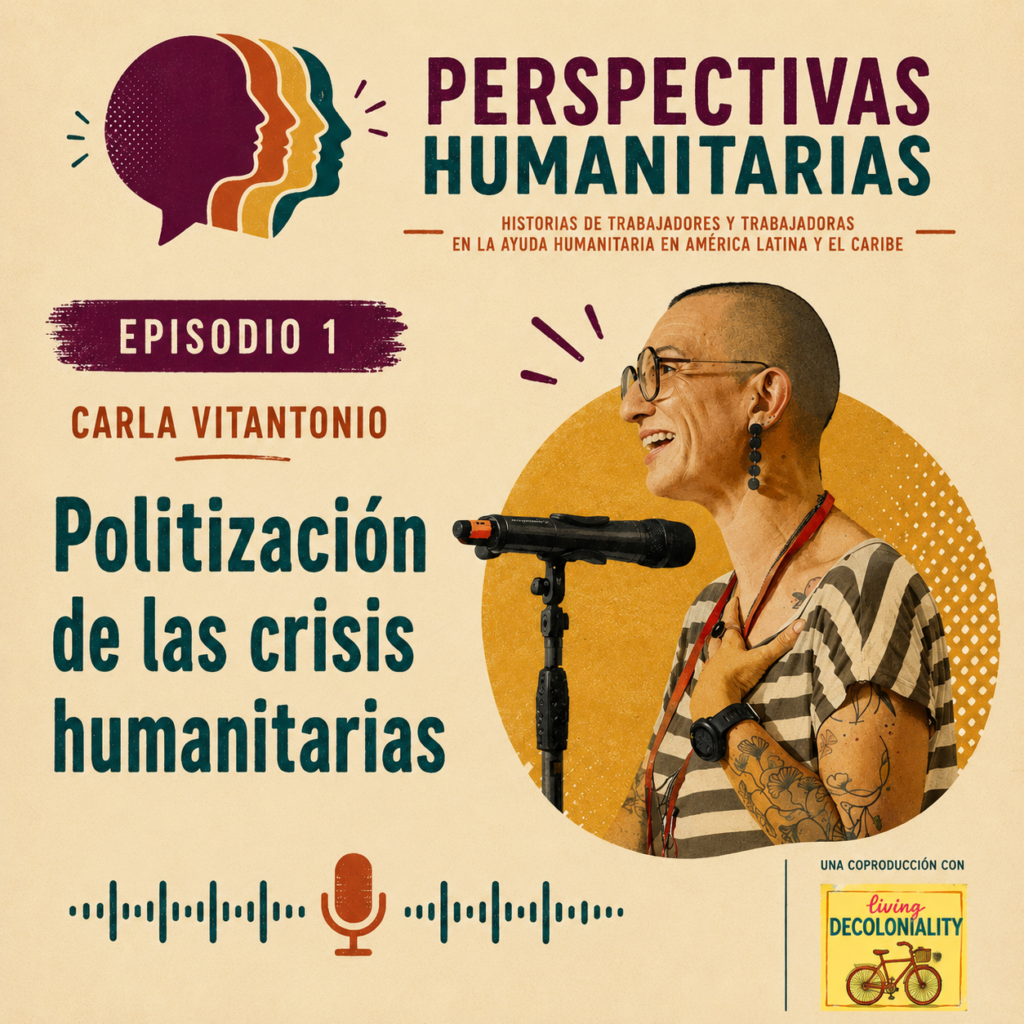
ENGLISH BELOW
—
[Música]
Estas escuchando perspectivas humanitarias, opiniones, reflexiones y dudas desde y sobre la ayuda
humanitaria en América Latina y Carribe, un podcast de Carla Vitantonio con el apoyo de Matilde Dani.
[Música]
Desde que empezò esta nueva crisis en Cuba, el país donde he vivido desde 2018,
hasta el final de 2025, nos hemos acostumbrado a los apagones.
Al principio, era un pocas horas por día, incluso el estado trataba de compartir alguna forma
de planificación, la ciudad estaba dividida en bloques, y cada cual podía ver cuando le
tocaban las tres o cuatro horas diarias de apagón.
Poco a poco, la situación ha ido empeorando, y desde el orden ejecutivo, 14.380, promulgado
por el presidente de Estados Unidos el 30 de enero 2026, los apagones se han hecho
más largos y más frecuentes.
Solo tenemos que cuatro o cinco horas de corriente eléctrica por día, sin ninguna planificación,
fuera de La Habana, dicen que la corriente solo llega una hora cada 30, 40, 50 horas.
No hay manera de almacenar la comida, de bombear agua en las casas, de conectarse a internet.
Pasamos los días esperando un cualquier ruido que nos diga que ha recrestado la corriente,
para poder correr a la barra ropa, a recargar un celular que sea.
Al principio, quien tenía el dinero para comprar el combustible por la izquierda, como dicen
aquí, lo que significa en el mercado negro, podía echar andar una planta eléctrica,
o por una hora o dos, pero esto ya no se ve.
Llega el apagón y se apaga la vida del siglo XXI.
Las personas ancianas han perdido la rutina que tenían gracias al noticiero de las ocho y treinta y la novela.
Los jóvenes casi no pueden estudiar, si todavía no se han ido a otro país
Y trabajar se trabaja cuando se puede y solo si necesario.
Apagó, más me lo pienso y más me doy cuenta de que esta palabra me hace pensar exactamente
a lo que pasa en un contexto de crisis humanitaria.
Se apaga la luz, se apagan las rutinas, se apagan los derechos, las voces,
todo se apaga, sin aviso y sin posibilidad de control.
Apagó.
Y así, he decidido de empezar este podcast con la idea del apagón.
Como lo que está pasando en Cuba y en mucho contexto de América Latina y Caribe.
Miraremos a esos apagones desde la perspectiva de los seres humanos que los enfrentan, profesionales
que viven y trabajan en contextos de crisis humanitaria y que han encontrado su camino,
su solución o quizás, su mecanismo de afrontamiento.
el alivio de su estrés.
Trataremos de entender lo que pasa cuando hay una crisis humanitaria, un apagón y lo haremos
escuchando a quienes viven y trabajan en estas situaciones.
Yo me llamo Carla Vitantonio y voy a acompañarles en ese espacio.
Ese podcast, Matilde Dani y yo, lo hemos hecho con lo que es asequible para quienes no
son profesionales de la industria de producción de contenido.
O sea, con el micrófono de nuestros teléfonos móviles y una laptop, la mía.
Para editar, utilizo una herramienta desarrollada bajo licencia Creative Commons.
¿Por qué sigo haciendo podcasts así?
La razón es que el podcast nació al principio de los años 2000 como una herramienta democrática,
algo que pudiera servir el propósito de aumentar las fuentes de información y mejorar
su calidad.
Si más personas pueden compartir contenido, estaremos más conectados y ojalá podremos
mejorar el mundo, también gracias a los fácil que transmitir información.
En aquellos años, esta forma de pensar era muy común.
En los años de los lectores MP3, de los social media utilizados para hacer la revolución
como fue en la primavera àrabe y también pocos años después en Birmania.
Con el tiempo, el podcast se ha profesionalizado y ahora parece que sea casi poco serio lanzar
un podcast si no tenemos una foto con un super micrófono o un mixer y un estudio de grabación.
Está muy bien tener esos medios, pero esto no mejora necesariamente la calidad del producto.
Yo vivo esta falsa profesionalización del podcast como un intento de limitar su uso y producción,
un intento.
Por parte de quienes, muchas veces, ya tienen el poder en la industria de la información,
de concentrar aún más este poder y de apropiarse de un medio tan democrático.
¿No sería la primera vez que eso pasa, no?
Piénselo bien.
Así que perspectiva humanitarias, que es un podcast que habla de seres humanos frente y crisis
humanitarias, es también un podcast donde, primero que todo, pasa la imperfección y la
diversidad de esos seres humanos.
Si les parece que el editing no es perfecto o que el grabado no es super limpio, traten
de disfrutarlo, porque están teniendo la posibilidad de entrar en la vida de las personas
y no en un neutralizado estudio de grabación.
Me hubiera gustado empezar el podcast con una entrevista a mis compañeros y compañeras cubanas,
las personas que con migo han enfrentado todos los huracanes de los últimos años, la pandemia
de COVID y la crisis actual, pero ellos no han querido hablar.
Aunque no me guste, tengo que aceptarlo.
Muchos de ellos desesperados por la falta de perspectiva, se han ido del país y están buscando
un futuro en otro lugar.
No quiere mirar atrás.
Otros, lo que siguen en Cuba, están agoveados por las tareas diarias de la necesidad de seguir
viviendo, cuidando de sus seres queridos, trabajando en una situación que a veces parece inaguantable.
Ellos no tienen deseo de hablar de esto y les entiendo.
Así que me toca hacer este primer episodio sola, lo hago porque necesitamos hablar de la
crisis cubana y entender una vez por todas que los derechos fundamentales de las personas
no pueden ser manipulados para obtener resultados políticos.
Así que voy a compartir algo de datos sobre lo que está pasando.
Cuba vive una crisis que es el efecto conjunto de factores internos y externos.
Los factores externos son lo que llamamos bloqueo, las medidas coercitivas unilaterales
impuestas desde hace 67 años por Estados Unidos y la inclusión de Cuba en el estado de
países esponsor del terrorismo.
Los factores internos se pueden resumir en la incapacidad, algunos dicen “falta de voluntad”
del gobierno cubano de buscar alternativas viables para priorizar el real bienestar de su pueblo.
La crisis de Cuba empieza por lo menos en los años de COVID, cuando el turismo, que era
la segunda fuente de divisa para el gobierno, se suspende.
Desde ahí, el país nunca se recupera, siguen cuatro fuertes huracanes en pocos años y se
suman la medida impuesta por Donald Trump a partir de enero de 2026.
Hoy, en Cuba, hay más que 96.000 personas a espera de una cirugía, porque toda operación
médica que no sea de urgencia ha sido cancelada por falta de combustible que alimente las
centrales eléctricas, o sea, los hospitales no tienen luz y tampoco tienen agua, porque
la falta de corriente afecta el sistema de bombeo central, los hospitales no tienen agua
y las casas tampoco.
Los niños con Cancer, en Cuba, cada año, alrededor de 1.400 niños se enferman, tenían hasta enero
75% de posibilidad de sobrevivir.
Hoy, solo tienen el 65.
Las casi 33.000 mujeres embarazadas en Cuba no pueden someterse al programa de diagnóstico
y prevención que les tocaría, ni logran recibir la alimentación necesaria para un embarazo
saludable.
Ellas y sus hijos están en riesgo.
Hacerte el combustible para un decente servicio de manejo de los desechos.
La basura se acumula por semanas en las calles, con aumento de moscas, ratas y enfermedades
vinculadas, dice la organización panamericana de la salud.
La personas agotadas terminan por quemarla, lo cual sabemos.
Trae consigo otros riesgos para la salud.
Si no fuera suficiente esto, añado que la falta de combustible ha abrendado la suspensión
de casi toda actividad productiva, incluso la parcial interrupción de la producción
de algúno medicamento.
No se produce comida, ni el estado puede importarla, porque no tiene la divisa necesaria.
Y obviamente, nadie quiere vender si un estado paga en peso cubano, una moneda que hoy no
vale nada.
La agricultura también está en una situación de suspensión, por falta de insumos y porque
las personas están demasiado agoveadas con las tareas esenciales para poder trabajar.
Con una hora o dos de luz cada 30 o 40 horas, en un país que se acerca a su temporada
más cálida, imagínense cómo se reorganizan la prioridad desde la vida.
Las personas pasan horas y horas buscando comida, todos los días, porque sin electricidad,
no hay forma de refrigerarla, ni almacenarla.
Y después hay que procesarla, la mayoría del país no tiene gas, así que se cocina con
carbón, lo cual es un proceso muy largo, pero también poco saludable.
La Organización Panamericana de la Salud declara que aumentarán las infecciones respiratorias
y pulmonares, y como en Cuba, las tareas del hogar casi son siempre un deber de la mujer,
las mujeres son las que más padecerán estas enfermedades.
La vida se vuelve así un listado de largas tareas, que demora mucho porque todo hay que
hacerlo manual, y si la luz vuelve, aunque sea en el medio de la noche, las personas se
apuran para encender una lavadora a preparar un poco de comida en la olla eléctrica, y
¿qué hacen las organizaciones humanitarias en Cuba?
El orden 14.380 afectó a ellas también.
En marzo, el PMA declaraba que había más que 20.000 toneladas de comida en ayuda humanitaria
parada en los puertos por falta de combustible para la grúa y la transportación.
Poco a poco las ONGs, la pocas que trabajan en el país, han encontrado algunas soluciones
a través de la importación con el sector privado, pero por razones de estatus, las
Naciones Unidas no pueden.
Y los fondos.
No obstante, el presupuesto extra de 2.000.000.000 de euro anunciado por ECHO, y alguna que
otra declaración de la cooperación española son pocos, pocos porque hay poca atención
hacia la crisis humanitaria en el mundo y pocos, porque de una forma más y màs evidente la política
instrumentaliza la ayuda humanitaria.
La narrativa mayoritaria europea hoy afirma que brindará ayuda humanitaria a Cuba, significa
de alguna forma seguir apoyando su gobierno.
Exactamente lo que dice el gobierno estadounidense.
Así que escuchamos otra vez la lógica de la asfixia, que un pueblo asfixiado se levantará
en contra de su gobierno.
Y evidentemente, si seguimos esta narrativa no importa el número de personas que sufren,
incluso que mueren.
Es una narrativa de conquista maquiavelica que nos dice que el fin, una supuesta democracia
en Cuba, o un nuevo mercado para los países de la minoría global.
Y ese fin justifica los medios.
Esta era la primera perspectiva que le brindamos con perspectivas humanitarias, un podcast
que es una ventana sobre el mundo y la subjetividad de quien trabaja la ayuda humanitaria.
Hasta el próximo episodio.
Has escuchado perspectivas humanitarias, opiniones, reflexiones y dudas desde y sobre la ayuda humanitaria
en América Latina y Carribe, un podcast de Carla Vitantonio con el apoyo de Matilde Dani.
Si te ha gustado dale like y suscríbete al canal en spreeker, Spotify y Apple podcast.
Perspectivas humanitarias ha sido creado con el apoyo de Humanitarian Studies Center
y del Observatorio Humanitario LAC, en coproducción con living decoloniality.
[Música]
**************************************************************************************************************************************
ENGLISH
01 Politicization of humanitarian crises
[Music]
You are listening to Humanitarian Perspectives, opinions, reflections and questions from and about humanitarian aid in Latin America and the Caribbean, a podcast by Carla Vitantonio with the support of Matilde Dani.
[Music]
Since this new crisis began in Cuba, the country where I lived from 2018 until the end of 2025, we have grown used to blackouts.
At first it was a few hours a day, and the state even tried to share some kind of schedule. The city was divided into blocks, and everyone could check when their three or four daily hours of blackout would fall.
Little by little the situation kept getting worse, and since Executive Order 14,380, issued by the President of the United States on January 30, 2026, the blackouts have become longer and more frequent.
Now we only have four or five hours of electricity a day, with no schedule at all. Outside Havana, they say power comes back for just one hour every 30, 40, or 50 hours.
There is no way to keep food, to pump water into homes, or to connect to the internet.
We spend our days waiting for any sound telling us the power has come back, so we can run to do the laundry, to charge whatever phone we have.
At first, whoever had money to buy fuel “on the left,” as they say here, meaning on the black market, could run a generator for an hour or two, but even that is no longer possible.
The blackout comes, and twenty-first century life shuts off.
Older people have lost the routine they had thanks to the eight-thirty news and the soap opera.
Young people can barely study, if they haven’t already left for another country.
And people work when they can, only if necessary.
Blackout. The more I think about it, the more I realize that this word makes me think exactly of what happens in a humanitarian crisis context.
The light goes out, routines go out, rights go out, voices go out, everything goes out, without warning and without any possibility of control.
Blackout.
And so I decided to start this podcast around the idea of the blackout, as with what is happening in Cuba and in many contexts across Latin America and the Caribbean.
We will look at these blackouts from the perspective of the human beings who face them, professionals who live and work in humanitarian crisis contexts and who have found their own path, their own solution, or perhaps their own coping mechanism, some relief for their stress.
We will try to understand what happens when there is a humanitarian crisis, a blackout, and we will do it by listening to those who live and work in these situations.
My name is Carla Vitantonio and I will be accompanying you in this space.
This podcast, Matilde Dani and I made it with what is accessible to those of us who are not professionals in the content production industry.
That is, with the microphones of our mobile phones and one laptop, mine.
To edit, I use a tool developed under a Creative Commons license.
Why do I keep making podcasts this way?
The reason is that the podcast was born in the early 2000s as a democratic tool, something that could serve the purpose of increasing sources of information and improving their quality.
If more people can share content, we will be more connected and hopefully we can improve the world, also thanks to how easy it has become to transmit information.
In those years, this way of thinking was very common.
In the years of MP3 players, of social media used to make revolution, as happened in the Arab Spring and, a few years later, in Myanmar.
Over time, podcasting has become professionalized, and now it seems almost unserious to launch a podcast if we don’t have a photo with a great microphone, a mixer, and a recording studio.
It’s fine to have those means, but this does not necessarily improve the quality of the product.
I experience this false professionalization of podcasting as an attempt to limit its use and production, an attempt
by those who, many times, already hold power in the information industry, to concentrate that power even further and to appropriate a medium that is meant to be so democratic.
Wouldn’t be the first time that happens, would it?
Think about it.
So Humanitarian Perspectives, a podcast that speaks about human beings facing humanitarian crises, is also a podcast where, above all, the imperfection and diversity of those human beings comes through.
If the editing seems not perfect to you, or the recording not super clean, try to enjoy it, because you are getting the chance to enter people’s real lives, and not a neutralized recording studio.
I would have liked to start the podcast with an interview with my Cuban colleagues and friends, the people who alongside me have faced all the hurricanes of recent years, the COVID pandemic, and the current crisis, but they did not want to talk.
Although I don’t like it, I have to accept it.
Many of them, desperate over the lack of any prospects, have left the country and are looking for a future elsewhere.
They don’t want to look back.
Others, who remain in Cuba, are overwhelmed by the daily tasks of the need to keep living, caring for their loved ones, working in a situation that sometimes seems unbearable.
They have no wish to talk about this, and I understand them.
So it falls to me to do this first episode alone. I do it because we need to talk about the Cuban crisis and understand, once and for all, that people’s fundamental rights cannot be manipulated to achieve political outcomes.
So I am going to share some data about what is happening.
Cuba is living through a crisis that is the combined effect of internal and external factors.
The external factors are what we call the blockade, the unilateral coercive measures imposed for 67 years now by the United States, and Cuba’s inclusion on the list of state sponsors of terrorism.
The internal factors can be summed up as the inability, some say lack of will, of the Cuban government to seek viable alternatives to prioritize the real wellbeing of its people.
Cuba’s crisis begins at least in the COVID years, when tourism, which was the government’s second source of foreign currency, comes to a stop.
From there, the country never recovers. Four powerful hurricanes follow within a few years, and then come the measures imposed by Donald Trump starting in January 2026.
Today in Cuba, more than 96,000 people are waiting for surgery, because every medical procedure that is not an emergency has been cancelled for lack of fuel to power the electrical plants. That is, hospitals have no electricity and no water either, because the lack of power affects the central pumping system. Hospitals have no water, and neither do homes.
Children with cancer in Cuba: each year around 1,400 children fall ill. Until January they had a 75% chance of survival. Today they only have 65%.
The nearly 33,000 pregnant women in Cuba cannot undergo the screening and prevention program they are entitled to, nor manage to get the nutrition needed for a healthy pregnancy.
They and their children are at risk.
There is no fuel for a decent waste management service.
Garbage piles up in the streets for weeks, with an increase in flies, rats, and related diseases, says the Pan American Health Organization.
Exhausted people end up burning it, which, as we know, brings other health risks.
If this were not enough, I would add that the fuel shortage has also driven the suspension of almost all productive activity, including the partial interruption of the production of some medicines.
No food is produced, nor can the state import it, because it doesn’t have the necessary foreign currency.
And obviously, no one wants to sell if a state pays in Cuban pesos, a currency that today is worth nothing.
Agriculture is also in a state of suspension, due to lack of supplies and because people are too overwhelmed with essential tasks to be able to work.
With one or two hours of light every 30 or 40 hours, in a country approaching its hottest season, imagine how life’s priorities get reorganized.
People spend hours and hours looking for food every day, because without electricity there is no way to refrigerate it or store it.
And then it has to be processed. Most of the country has no gas, so people cook with charcoal, which is a very long process, but also unhealthy.
The Pan American Health Organization states that respiratory and lung infections will increase, and since in Cuba household chores are almost always a woman’s duty, women are the ones who will suffer most from these illnesses.
Life thus becomes a list of long tasks, which takes a long time because everything has to be done by hand, and if the power comes back, even in the middle of the night, people rush to turn on a washing machine or prepare some food in the electric pot.
And what are the humanitarian organizations doing in Cuba?
Order 14,380 affected them too.
In March, the WFP reported that more than 20,000 tons of humanitarian food aid were stuck in the ports for lack of fuel for the cranes and transportation.
Little by little the NGOs, the few that work in the country, have found some solutions through imports via the private sector, but for status reasons the United Nations cannot.
And then there is funding.
Even so, the extra budget of 2 billion euros announced by ECHO, along with a few statements from Spanish cooperation, are little, little because there is little attention to the humanitarian crisis in the world, and little because, in an increasingly evident way, politics is instrumentalizing humanitarian aid.
The majority European narrative today claims that providing humanitarian aid to Cuba would in some way mean continuing to support its government.
Exactly what the U.S. government says.
So once again we hear the logic of suffocation, that a suffocated people will rise up against its government.
And evidently, if we follow this narrative, it does not matter how many people suffer, or even die.
It is a Machiavellian narrative of conquest that tells us that the end, a supposed democracy in Cuba, or a new market for the countries of the global minority, and that end justifies the means.
This was the first perspective we brought you on Humanitarian Perspectives, a podcast that is a window onto the world and the subjectivity of those who work in humanitarian aid.
Until the next episode.
You have listened to Humanitarian Perspectives, opinions, reflections and questions from and about humanitarian aid in Latin America and the Caribbean, a podcast by Carla Vitantonio with the support of Matilde Dani.
If you liked it, give it a like and subscribe to the channel on Spreaker, Spotify, and Apple Podcasts.
Humanitarian Perspectives was created with the support of the Humanitarian Studies Center and the LAC Humanitarian Observatory, in co-production with Living Decoloniality.
[Music]
[Music]