Episodio 2, terremoto en Venezuela, dignidad y no hacer daño
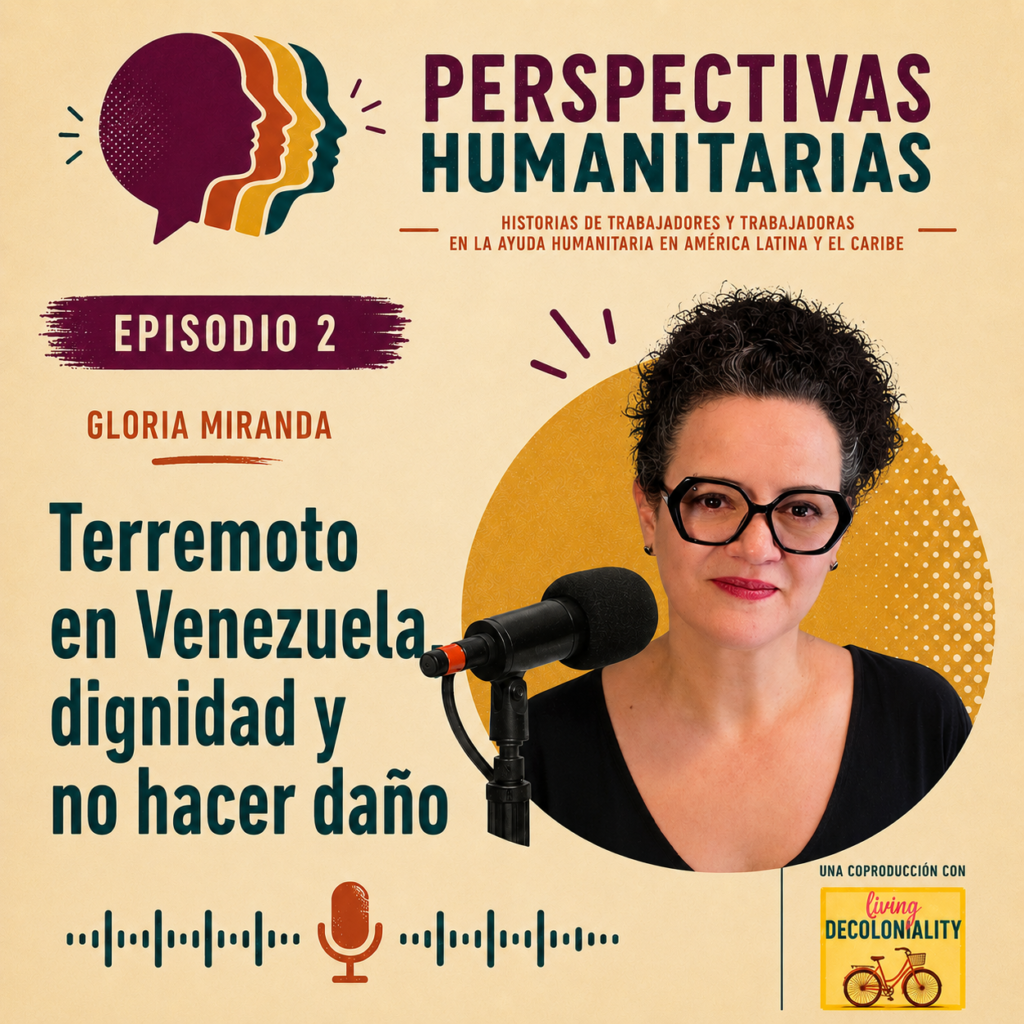
ENGLISH BELOW
—
[Música]
Estás escuchando Perspectivas Humanitarias, opiniones, reflexiones y dudas desde y sobre la ayuda
humanitaria en América Latina y Carribe un podcast de Carla Vitantonio con el apoyo de Matilde
Dani.
[Música]
Bienvenidos y bienvenidas a un nuevo episodio de Perspectivas Humanitarias. Yo soy Carla Vitantonio
y hoy conmigo está Gloria Miranda que nos habla desde Envigado Antioquia, Colombia. Bienvenida,
Gloria.
Hola Carla, muchísimas gracias por tenerme en tu podcast.
Gloria, la primera pregunta que tengo para ti es: preséntate para mí y para quienes nos escuchan
Bueno, yo soy Gloria Miranda, nací en Yarumal Antioquia en 1972 y me gradué del Departamento
de Psicología de la Universidad de Antioquia en 1998. Desde que me gradué he dedicado mi actividad
profesional a la respuesta humanitaria en Colombia y en otros países de la región,
incluida Venezuela.
Y después de más de 20 años de trabajo en terreno, ahora soy tutora y investigadora para el Instituto
de Estudios sobre conflicto de Acción Humanitaria y IECAH para la región de Latinoamérica y el carribe.
Gloria, yo te he conocido en la última reunión del Observatorio Humanitario América
Latina y caribe.
Me ha tocado mucho tu preocupación para aterrizar los principios humanitarios en la práctica
y sé que en esos últimos tiempos, especialmente después del terremoto en Venezuela, has estado
preocupada con alguno de sus principios humanitarios.
¿Quieres hablarnos un poco de esto?
Sí, Carla, gracias por tu pregunta. Verás, desde siempre que hemos estado trabajando
en la respuesa humanitaria, hay dos conceptos que se han popularizado mucho.
Uno de eseos es el asistencialismo, y otro es el humanitarismo.
Y ambos conceptos que se utilizan de forma pejorativa para decir cómo que la acción humanitaria
se limita simplemente a hacer entregas se alejan mucho de lo que es la Acción Humanitaria
propiamente dicha.
Como mencionaba, la Acción Humanitaria necesariamente tiene que basarse en los como mínimo, en los cuatro
principios humanitarios de imparcialidad, humanidad, independencia y neutralidad.
Y este último principio, uno de los que más debate genera, porque algunas interpretaciones
dicen que la neutralidad se aleja de la posibilidad de dar testimonio o de sentar posiciones,
pero no necesariamente es así.
Se trata fácilmente de evitar actuar de manera que pueda ser interpretado como que estás
favoreciendo alguna de las parvencias, en el caso de un nuevo principio.
Por ejemplo, cuando ocurre una situación como la que está pasando en Venezuela, que nos
impacta de una manera tan brutal, sobre todo porque es una situación súbita que podría
ser comparable con otras situaciones que están pasando con crisis más prolongadas en el resto
del mundo, de lo que está pasando en la franja de Gaza.
Pero digamos que en términos generales, toda la movilización de la solidaridad, de las
personas, de las buenas voluntades, termina precisamente apuntando a brindar ese tipo
de asistencia.
Ese asistencialismo o humanitarismo que es utilizado con una connotación negativa, se utiliza
para referirse a ayudas puntuales que alivian necesidades inmediatas, pero que no necesariamente
transforman la vida de las personas o las condiciones que generaron las crisis.
Pero esa crítica no debería confundirse con la acción humanitaria profesional, vamos
a usar más allá de la asistencia inmediata.
¿Y abarca qué?
Además de la distribución tradicional que se hace de alimentos a agua o albergue durante
los primeros días de la emergencia, que es imprescindible porque es justo lo que puedes
salvar vidas, el problema aparece cuando se piensa que eso es toda la acción humanitaria,
la acción humanitaria incluye, entre otras cosas, la preparación, el análisis de necesidades,
la coordinación, la protección, la rendición de cuentas, que es la responsabilidad que tenemos
cuando pretendemos ayudar y también elementos para la recuperación temprana.
Y un punto que para mí es particularmente muy importante es el involucramiento de actores
locales en la respuesta, que no sea esa respuesta colonialista.
Y otro elemento que sé que también te interesa mucho y es el tema de cómo la acción humanitaria
no exacerbe las desigualdades, especialmente la desigualda de poder, la desigualdad de acceso
a recursos que tradicionalmente hay en muchas de las comunidades afectadas, independientemente
del nivel de desarrollo de cultura que tenga el lugar donde ocurren las crisis, siempre
la crisis puede exacerbar esas desigualdades.
Entonces cómo la acción humanitaria puede ayudar a que no se exacerben y se busquen más
equilibrios?
Te escucho, Gloria, y pienso que sea en tu país que en el mío hay algo que escuchamos
bastante a menudo y que con las buenas intenciones está empedrado el camino hacia el infierno.
Y eso me hace pensar mucho en ti en tus reflexiones de la última temporada.
Quiero compartir un poco con nosotros.
Claro que sí.
Mira que retomando el tema de Venezuela y que lo hemos visto en las crisis sobre todo
cuando son súbitas, se movilizan muchas buenas voluntades.
Y esas buenas voluntades algunas veces están asociadas a desconfianza, a desconfianza frente
a las instituciones gubernamentales, pero también desconfianza frente a las organizaciones humanitarias.
Y por esas desconfianzas se pretenden muchas veces hacer llegar la ayuda de manera directa.
Pero lo hemos visto por ejemplo en Venezuela o lo vi yo personalmente en Ecuador, motocicletas
llevando paquetes de pañales.
Entonces el señor de la motocicleta se acerca a una señora y le pregunta esto: cuantos
hijos tiene, cuantos bebés tiene, tengo un bebé y le entrega un pañal y un pañal sirve
para lo que sirve un pañal.
Pero esa motocicleta con otras 15 están bloqueando el acceso de los equipost de búsqueda
y recate.
Están bloqueando el acceso de las ambulancias o estar haciendo muchísimo màs lento.
el acceso de los vehículos que llevan las paquetes de pañales enteras para las señoras
que tienen bebés, con los sistemas para la disposición final de sus pañales etcétera.
Entonces ese ejemplo me gusta para los temas de cómo una buena intención puede generar
daño y tengo muchos otros elementos.
No sé si quieres que te cuente otro que me gusta mucho.
Sí, me gustaría que tu me contaras algo y me gustaría también que tu exploraras un
poco ese concepto que las buenas intenciones también necesitan otra cosa como la preparación
por ejemplo y mucho más.
Ah bueno, entonces ese me permite introducir uno que me parece particularmente peligroso y
es la idea de la entrega del leche o sucedáneos de leche que llaman las personas
expertas como la leche de fórmula para bebés.
Cualquier mamá y cualquier persona en una situación normal creería que eso realmente
es algo que se necesita mucho.
Pero si una entrega de leche se hace sin las condiciones adecuadas, sin el acompañamiento
adecuado eso que se salen de generar daño en que consiste la preparación en este caso,
por ejemplo, en saber que las personas van a disponer de agua potable para la preparación
de esa leche, en garantizar que tienen sistema de almacenamiento, que tienen cómo lavar
unos recipientes o desinfectar unos recipientes en los que se va a utilizar esa leche.
de lo contrario pueden terminar entregando una leche que llega a los bebés de forma
contaminada.
Entonces las organizaciones humanitarias que trabajan todos los sectores de la respuesta
humanitaria, en este caso, por ejemplo, el tema de la infancia y el tema de la nutrición
o de la lactancia materna, tienen que articular como todos esos aspectos son importantes
a la hora de hacer una acción como eso.
Entonces, la preparación para la respuesta que va más allá de la gestión de riesgo en
estos casos también es muy importante, es còmo las organizaciones con tiempo, con anterioridad
se han venido preparando para responder de forma coordinada, de forma complementaria, de forma
organizada a una crisis que se presenta en un momento de la vida.
Y entonces, Gloria, si tú pudieras sugerir a una persona que quiere apoyar los damnificados y las damnificadas
en el terremoto de Venezuela, ¿qué le pudieras decir?
Dos cosas, hay que calcular bien quando ponerse en el lugar de la persona afectada.
Realmente esa ropa usada que está sacando de tu clòset, que está aprovechando para
limpiar el closet y la conciencia con la pretensión de ayudar si eso realmente puede
ser algo que en este momento una persona necesita.
Y como muchas veces las organizaciones que están en el territorio tienen que dedicar
más tiempo a clasificar este tipo de cosas antes de comenzar con las distribución.
Eso es la primera.
Esa primera tiene un elemento: si puedes priorizar las ayudas en efectivo, es mucho mejor.
Hay organizaciones confiables.
Yo justo ayer le decía a una amiga que me preguntó sobre la Crux Roja, la Crux Roja de Venezuela
tiene la mayoría de trabajo lo hacen las personas voluntarias, que son personas
que también han sido afectadas, que sus familiares están afectadas.
Entonces, cualquier peso que le entregues a la Crux Roja con toda seguridad va a tener
una buena distribución.
Y lo segundo que diría es, expertos.
El momento en que están haciendo la búsqueda y el rescate es un momento donde se necesita
muchísima especialidad.
Se necesitan unas características muy particulares de preparación, de entrenamiento de equipos para
hacer esa respuesta.
Deja que las personas expertas la hagan y date un tiempo porque cuando pasa toda esta atención
mediática es cuando empieza a sentirse el vacío.
Ahí es cuando la gente necesita la ropa, suponiendo que fuera a hacer entregas de ropa.
Me gustaría introducir una historia que me gusta mucho y es hace muchísimos años en un
desplazamiento masivo que atendimos aquí en Colombia.
Residimos muchísima, muchísima ropa de personas con buenas intenciones de verdad.
Y en ese momento, pues estaba todo muchísimo más joven y más desocupada por decirlo de alguna
manera.
Lo que hicimos fue montar una boutique y le dimos a las personas una especie de pseudo-
moneda para que pudieran ingresar a la boutica y escoger que ropa querían usar.
Y en medio de ese desplazamiento una señora muy conmovida, escogió el chaleco más feo
que nos había parecido a nosotros, que incluso nos habíamos boclado del pobre chaleco
porque era amarillo yo con lentejuelas y brillos.
Y cuando la señora vio ese chaleco se conmovió mucho, se lo puso y no podía creer que,
claro, como la habíamos puesto precio a las prendas, no podía creer que ese chaleco costara
tan poco, se lo midiò y nos cuenta muy conmovida que a pesar del desplazamiento la boda de su
hija continuaba y ella no tenía vestido para ponerse.
Y con ese chaleco sobre su vestido negro viejito iba a quedar como la madre de la novia
más elegante del mundo.
Y a partir de ese momento, Carla yo entendí qué era la dignidad.
Entonces el mensaje es ese: si vas a responder con algo que sea de manera digna; y la dignidad por
ejemplo entre en el tema de la entregar ropa, es parte de que la gente pueda efectivamente
escoger esa ropa, la ropa que se acomoda a sus usos, a sus costumbres, a sus necesidades.
No son tus necesidades las que determinan qué es lo que la otra persona necesita.
No es tu deseo deayudar el que determina mi necesidad.
Muchísimas gracias.
Esta era la voz de Gloria Miranda, yo soy Carla Vitantonio y han escuchado otro episodio
de “Perspectivas Humanitarias”.
Has escuchado Perspectiva Humanitarias, opiniones, reflexiones y dudas desde y sobre la ayuda
humanitaria en América Latina y Carribe, un podcast de Carla Vitantonio con el apoyo de
Matilde Dani.
Si te ha gustado dale like y suscríbete al canal en Spreaker, Spotify y Apple Podcast.
“Perspectivas Humanitarias” ha sido creado con el apoyo de lo Humanitarian Studies Center
y del Observatorio Humanitario LAC en co-producción con Living Decoloniality.
[Música]
***********************************************************************************************************************************
[Music]
You are listening to Humanitarian Perspectives, opinions, reflections and questions from and about humanitarian aid in Latin America and the Caribbean, a podcast by Carla Vitantonio with the support of Matilde Dani.
[Music]
Welcome to a new episode of Humanitarian Perspectives. I am Carla Vitantonio and today with me is Gloria Miranda, who speaks to us from Envigado, Antioquia, Colombia. Welcome, Gloria.
Hello Carla, thank you so much for having me on your podcast.
Gloria, the first question I have for you is: introduce yourself for me and for those listening to us.
Well, I am Gloria Miranda, I was born in Yarumal, Antioquia in 1972, and I graduated from the Department of Psychology at the University of Antioquia in 1998. Since graduating, I have dedicated my professional activity to the humanitarian response in Colombia and in other countries in the region, including Venezuela.
And after more than 20 years of fieldwork, I am now a tutor and researcher for the Institute for Studies on Conflict and Humanitarian Action, and IECAH, for the Latin America and Caribbean region.
Gloria, I met you at the last meeting of the Latin America and Caribbean Humanitarian Observatory.
I have been very struck by your concern with grounding humanitarian principles in practice, and I know that in recent times, especially after the earthquake in Venezuela, you have been concerned about some of the humanitarian principles.
Would you like to talk to us a bit about this?
Yes, Carla, thank you for your question. You see, for as long as we’ve been working in humanitarian response, there are two concepts that have become very popular.
One of them is assistentialism, and the other is humanitarianism.
Both concepts are used in a pejorative way to suggest that humanitarian action is simply limited to making deliveries, which is far from what Humanitarian Action properly speaking actually is.
As I mentioned, Humanitarian Action necessarily has to be based on, at a minimum, the four humanitarian principles of impartiality, humanity, independence, and neutrality.
And this last principle is one of the ones that generates the most debate, because some interpretations say that neutrality rules out the possibility of bearing witness or taking positions, but that’s not necessarily the case.
It’s really more about avoiding acting in a way that could be interpreted as favoring one of the sides, in the case of this principle.
For example, when a situation like the one happening in Venezuela occurs, which impacts us in such a brutal way, especially because it’s a sudden situation that could be compared to other, more prolonged crisis situations happening elsewhere in the world, like what’s happening in the Gaza Strip.
But let’s say that, in general terms, all this mobilization of solidarity, of people, of good will, ends up precisely aiming to provide that kind of assistance.
That assistentialism or humanitarianism, when used with a negative connotation, refers to one-off aid that relieves immediate needs but doesn’t necessarily transform people’s lives or the conditions that gave rise to the crisis.
But that criticism shouldn’t be confused with professional humanitarian action, which goes far beyond immediate assistance.
And what does it cover?
Besides the traditional distribution of food, water, or shelter during the first days of the emergency, which is essential because it’s exactly what can save lives, the problem arises when people think that’s all humanitarian action is. Humanitarian action includes, among other things, preparedness, needs analysis, coordination, protection, accountability, which is the responsibility we have when we set out to help, and also elements for early recovery.
And a point that I find particularly important is the involvement of local actors in the response, so that it isn’t a colonialist response.
And another element I know you’re also very interested in is the question of how humanitarian action doesn’t worsen inequalities, especially the inequality of power, the inequality of access to resources that traditionally exists in many affected communities, regardless of the level of development or culture of the place where the crises occur. Crisis can always worsen those inequalities.
So how can humanitarian action help make sure they aren’t worsened, and instead more balance is sought?
I hear you, Gloria, and I think that in your country, as in mine, there’s something we hear quite often: that the road to hell is paved with good intentions.
And that makes me think a lot about you and your reflections from the last season.
I’d like to share a bit with us.
Of course.
Look, going back to the topic of Venezuela, and as we’ve seen in crises, especially when they’re sudden, a lot of good will gets mobilized.
And that good will is sometimes tied to distrust, distrust toward government institutions, but also distrust toward humanitarian organizations.
And because of that distrust, people often try to get aid delivered directly.
But we’ve seen, for example in Venezuela, or I saw it myself in Ecuador, motorcycles carrying packages of diapers.
So the man on the motorcycle goes up to a woman and asks her: how many children do you have, how many babies do you have, I have one baby, and he hands her a diaper, and one diaper is worth as much as one diaper.
But that motorcycle, along with another 15, are blocking access for search and rescue teams.
They’re blocking access for ambulances, or making it much slower for vehicles carrying whole packages of diapers to reach the women who have babies, along with the systems for disposing of those diapers, and so on.
So I like that example to talk about how a good intention can cause harm, and I have many other examples.
I don’t know if you’d like me to tell you another one I like a lot.
Yes, I’d like you to tell me something, and I’d also like you to explore a bit that idea that good intentions also need something else, like preparedness, for example, and much more.
Well, that lets me bring up one that I find particularly dangerous, which is the idea of giving out milk, or milk substitutes, as experts call it, meaning baby formula.
Any mother, any person in a normal situation, would think that’s really something that’s badly needed.
But if milk is distributed without the right conditions, without the right support, that can end up causing harm. What does preparedness mean in this case?
For example, knowing that people will have access to drinking water to prepare that milk, making sure they have a storage system, that they have a way to wash or disinfect the containers that milk is going to be used in.
Otherwise, they can end up giving babies milk that reaches them contaminated.
So humanitarian organizations working across all sectors of the humanitarian response, in this case, for example, on child welfare and nutrition, or breastfeeding, have to work out how all those aspects matter when carrying out an action like that.
So preparedness for the response, which goes beyond risk management in these cases, is also very important. It’s about how organizations, ahead of time, in advance, have been preparing themselves to respond in a coordinated, complementary, organized way to a crisis that arises at some point in life.
So then, Gloria, if you could suggest something to someone who wants to support the people affected by the earthquake in Venezuela, what would you tell them?
Two things: you have to really think about putting yourself in the shoes of the affected person.
That used clothing you’re pulling out of your closet, that you’re using as a chance to clean out your closet, and your conscience, with the intention of helping, is that really something a person needs right now?
And a lot of the time, organizations on the ground have to spend more time sorting through that kind of thing before they can even start distribution.
That’s the first thing.
That first point has another element: if you can prioritize cash assistance, that’s much better.
There are trustworthy organizations.
Just yesterday I was telling a friend who asked me about the Red Cross, the Venezuelan Red Cross does most of its work through volunteers, people who have also been affected themselves, whose own families have been affected.
So any amount you give to the Red Cross will, with total confidence, be well distributed.
And the second thing I’d say is: experts.
The moment when search and rescue is happening is a moment that requires a huge amount of specialization.
Very particular characteristics of preparedness, of team training, are needed to carry out that response.
Let the experts do it, and give it some time, because once all the media attention passes is when the void starts to be felt.
That’s when people need the clothes, assuming clothing donations are what’s being done.
I’d like to bring up a story I really like, from many years ago, during a mass displacement we responded to here in Colombia.
We received an enormous, enormous amount of clothing from people with truly good intentions.
And at that time, well, everything was much younger and less established, so to speak.
What we did was set up a boutique, and we gave people a kind of pseudo-currency so they could go into the boutique and choose which clothes they wanted to wear.
And in the middle of that displacement, a woman, very moved, chose the ugliest vest we had, one we’d even made fun of ourselves, because it was yellow with sequins and sparkles.
And when the woman saw that vest she was very moved, she put it on, and she couldn’t believe, of course, since we had put prices on the items, she couldn’t believe how little that vest cost. She tried it on and told us, very moved, that despite the displacement, her daughter’s wedding was still going ahead, and she didn’t have a dress to wear.
And with that vest over her old black dress, she was going to look like the most elegant mother of the bride in the world.
And from that moment on, Carla, I understood what dignity was.
So the message is this: if you’re going to respond, do it in a dignified way. And dignity, for example when it comes to giving out clothes, is partly about people being able to actually choose those clothes, the clothes that fit their uses, their customs, their needs.
It’s not your needs that determine what the other person needs.
It’s not your desire to help that determines my need.
Thank you so much.
That was the voice of Gloria Miranda. I am Carla Vitantonio, and you’ve listened to another episode of “Humanitarian Perspectives.”
You have listened to Humanitarian Perspectives, opinions, reflections and questions from and about humanitarian aid in Latin America and the Caribbean, a podcast by Carla Vitantonio with the support of Matilde Dani.
If you liked it, give it a like and subscribe to the channel on Spreaker, Spotify, and Apple Podcasts.
“Humanitarian Perspectives” was created with the support of the Humanitarian Studies Center and the LAC Humanitarian Observatory, in co-production with Living Decoloniality.
[Music]